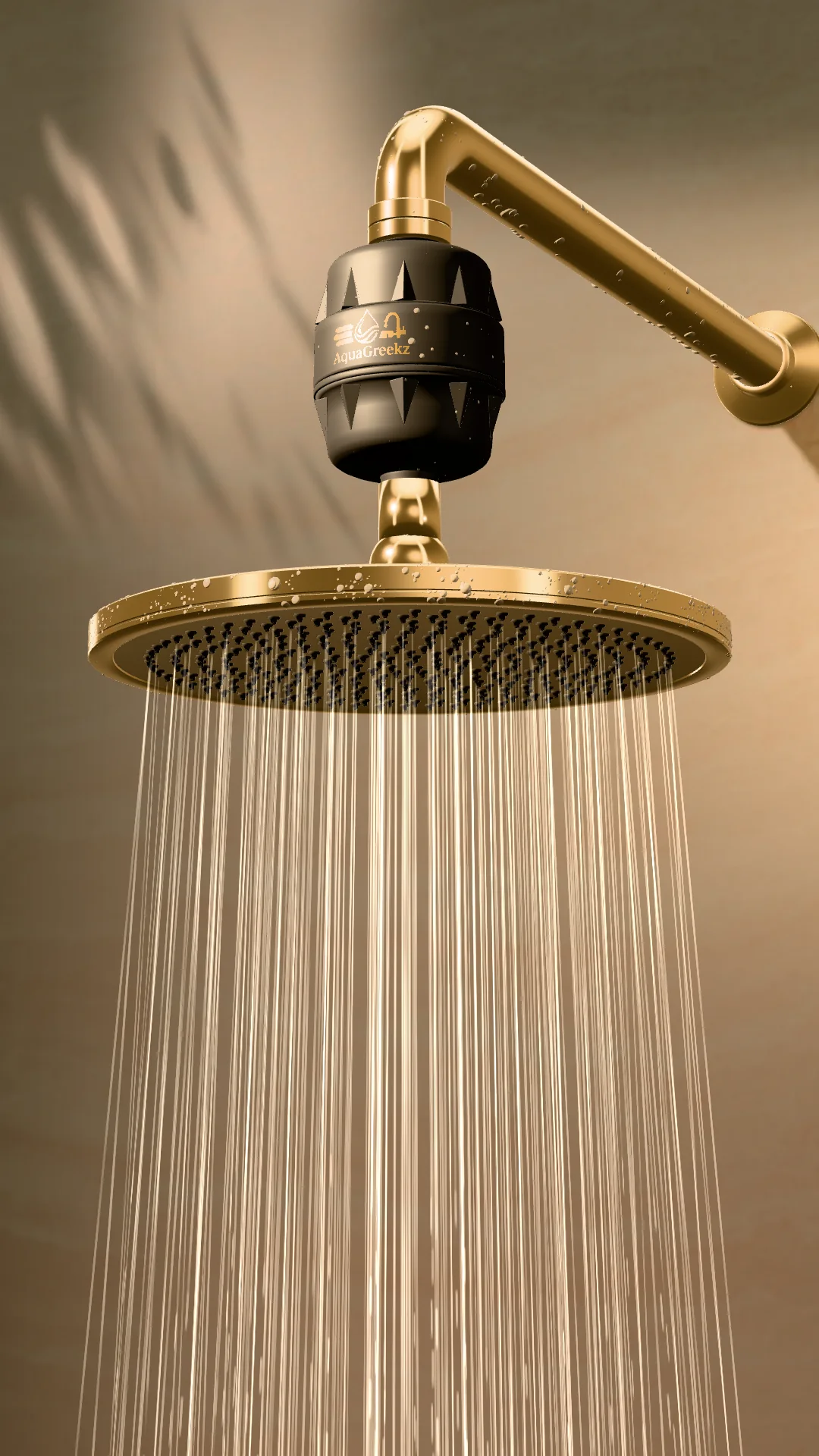
13 stages of filtration, built for your daily shower.
Water passes through 13 layers of filtration media, each with a specific role.
Ultra-fine mesh and PP cotton at both ends give several chances to retain physical particles, and protect the specialised media held between them.
Coconut-shell activated carbon, vitamin C and calcium sulfite are included as complementary chlorine-treatment media. How well they work depends on cartridge design, media quantity, flow rate and contact time.
01 · Ultra-Fine Mesh (Inlet)
First-line particle protection
The first barrier at the inlet. It is designed to catch larger suspended particles such as visible sediment, sand and rust flakes before water reaches the inner layers.
- Helps capture larger suspended particles and sediments.
- Reduces the amount of debris entering the inner filtration layers.
- Helps protect the filtration media from premature clogging.
- Supports consistent water flow when maintained properly.
02 · PP Cotton (Inlet side)
Fine sediment filtration
A fibrous polypropylene layer that retains suspended impurities passing the mesh. Depending on its density and micron rating, it can help reduce fine dust, rust particles and other suspended sediment.
- Helps reduce fine suspended particles.
- Captures additional sediment and rust.
- Supports clearer-looking shower water.
- Helps protect the performance of downstream filtration media.
03 · Alkaline Ceramic Balls
Water conditioning and pH support
A conditioning medium that may influence certain water characteristics, including pH, depending on its composition, the water chemistry, contact time and operating conditions. Any pH change should be established by before-and-after testing.
- Designed to support water conditioning.
- May influence water pH depending on the media composition.
- Can be evaluated through before-and-after pH testing.
04 · Maifan Stone
Mineral-based water conditioning
A mineral-containing material that may release small quantities of selected minerals during contact. The amount and type depend on the stone, its surface area, the water chemistry and contact time; its presence does not guarantee a specific mineral concentration or a health benefit.
- Provides a mineral-based filtration medium.
- May influence the mineral composition of water.
- Can be assessed through laboratory analysis of the filtered water.
05 · KDF 55
Reduction of selected chemical contaminants
A copper-zinc alloy medium that works through oxidation-reduction reactions. Under suitable conditions it can help reduce free chlorine and certain dissolved contaminants; effectiveness depends on water chemistry, temperature, flow rate, media quantity and contact time.
- Can help reduce free chlorine under suitable conditions.
- May reduce certain dissolved contaminants.
- Provides a chemical-treatment stage beyond basic sediment filtration.
06 · Microporous Ceramic Balls
Additional physical filtration
A porous medium that adds surface area inside the cartridge. Depending on its pore characteristics, construction and how water flows through it, it may assist in retaining suspended particles. It complements the other sediment layers rather than replacing a validated fine-particle filter.
- May assist in retaining certain suspended particles.
- Provides additional surface area within the filtration system.
- Complements the other sediment-filtration layers.
07 · Vitamin C
Residual chlorine neutralisation
Ascorbic acid can react with residual chlorine. When properly formulated and present in sufficient quantity, it can help neutralise chlorine before water reaches the outlet. Because it is consumed in the reaction, its effectiveness may change as the filter is used.
- Can help neutralise residual chlorine.
- May reduce chlorine-related odour.
- May help reduce chlorine exposure during showering when effective under actual use conditions.
08 · Coconut Activated Carbon
Adsorption of odour-causing compounds
Coconut-shell carbon is highly porous, with adsorption sites that can capture certain dissolved substances. It is commonly used to reduce free chlorine and selected organic compounds that cause unpleasant odour; performance depends on carbon quality, quantity, contact time and flow rate.
- Helps reduce unpleasant chlorine odour when adequately designed.
- Can adsorb selected organic compounds.
- Helps improve the sensory quality of water.
09 · Germanium Balls
Specialised water-conditioning media
A specialised medium included for water conditioning, based on the properties of the particular material used. Its actual contribution should be established by evaluating the material and its interaction with water.
10 · Dechlorination Balls (Calcium sulfite)
Additional chlorine reduction
Calcium sulfite removes residual chlorine through a chemical reaction, adding a chlorine-reduction stage alongside activated carbon and the other compatible media. The degree of reduction depends on the media amount and condition, incoming chlorine, temperature, flow rate and contact time.
- Can help reduce residual chlorine under suitable conditions.
- Complements the chlorine-treatment function of other media.
- May help reduce chlorine-related odour when effective.
11 · Magnetic Energy Ceramic Balls
Water-conditioning layer
Ceramic media combined with a magnetic-conditioning concept, included as a supplementary conditioning stage. Its contribution should be described from the actual material specification and independently demonstrated performance.
12 · PP Cotton (Outlet side)
Final sediment polishing
A second polypropylene layer near the outlet, intended to retain suspended particles that remain after the preceding media. Its effectiveness depends on its micron rating, construction, condition and the cartridge’s flow.
- Provides an additional sediment-filtration stage.
- Helps retain residual suspended particles.
- Helps reduce the potential passage of loose media particles.
13 · Ultra-Fine Mesh (Outlet)
Final filtration guard
A protective barrier at the outlet end, intended to retain residual particles and help prevent loose media from travelling out with the water. With the inlet mesh and the second PP cotton layer it completes the cartridge’s physical filtration.
- Provides a final physical barrier.
- Helps retain residual particles and loose filtration media.
- Supports cleaner-looking water at the outlet.